POLITICS
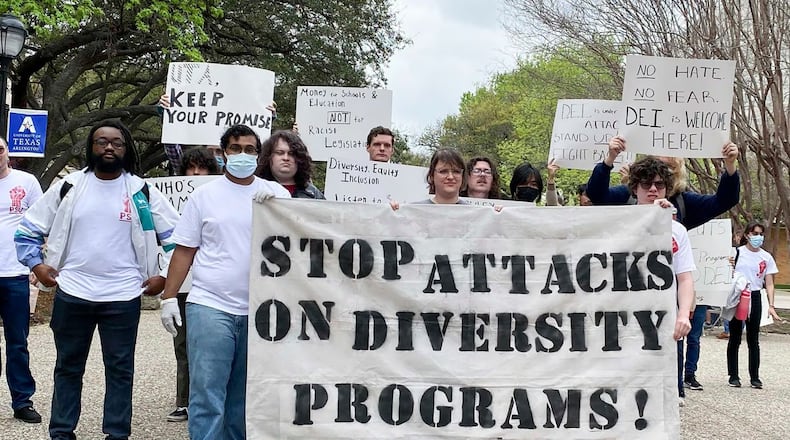
Education Department Bans DEI From Schools, Universities
Written and Researched By: Rui Zheng
Edited By: Kate Sum

WASHINGTON — Public schools and universities have received an ultimatum from the Trump Administration: get rid of Diversity, Equity and Inclusion programs, or lose federal funding. This move is one of many that the new administration has enacted in its mission to erase DEI from American institutions and to cut spending viewed to be wasteful by the administration. In a letter to state education departments on Feb. 14, the U.S. Department of Education threatened to pull federal funding from public schools and universities that receive federal funding if they are not in compliance with their new policies by the end of the month. The Department used Title VI of the Civil Rights Act of 1964 and the U.S. Constitution’s Equal Protections Act to back their decision, claiming that DEI policies are discriminatory and illegal. It further referenced the 2023 Supreme Court decision against affirmative action at Harvard to elaborate on what qualifies as racial bias, stating “it would, for instance, be unlawful for an educational institution to eliminate standardized testing to achieve a desired racial balance or to increase racial diversity.” The letter was also posted by the Department of Government Efficiency (DOGE) on X, stating that “institutions which fail to comply may face a loss of federal funding.” This funding includes Title IV, student loans, state funding for curriculum development, free or reduced lunch programs, and support for students with special needs.
However, enforcing compliance by the given 14-day deadline could prove more difficult than the administration planned. Some universities have already taken action to comply with the DOE’s requirements, such as state universities in North Carolina and Colorado. For the University of North Carolina, the “diversity” course requirement (similar to Binghamton University’s Diversity, Equity, Inclusion, and Social Justice general education requirement) will no longer be needed for graduation, though a spokesman stated that the courses themselves will still be offered. Earlier this month, the United States Military Academy at West Point “axed clubs centered around gender, race, ethnicity and sexuality, such as the Asian-Pacific Forum Club, the National Society of Black Engineers, and the Society of Women Engineers.” Other educational institutions have resisted the policy, such as Princeton University, whose president “urged the community to ‘Keep Calm and Carry On.’” The letter itself was vague, without direct statements of what compliance would look like and how far-reaching a DEI ban would go. Thus, its scope and legality have been questioned, putting it (as well as the administration’s other DEI-related policies) up to legal scrutiny.
Trump’s Deportation Efforts Towards Undocumented Immigrants
Written by: Carmen Tan
Researched by: Andy Huang
Edited by: Jessica Kwok

WASHINGTON — President Trump’s re-election and first day in office meant a multitude of things. One particular subject is a crackdown “to reduce immigrants entering the country” no matter their status. As Trump continues this endeavor, he intends to expand this parameter to include not only people at the borders but those in “sensitive areas like schools and churches,” which would affect children as well, leaving many populations concerned.
The United States historically has been a country that allows immigrants to enter in search of careers and better futures, what may otherwise be known as “the American Dream.” As Trump restricts the autonomy of immigrants, this notion may be minimized even more. Many areas and places in the U.S. are considered to be sanctuary cities where there is less pressure on immigrants as their information may be more protected from federal immigration officers so long as certain conditions are met. Currently, Trump’s efforts continue to increase, causing schools across the country to be more concerned for students who may be removed from their classroom. As Trump delves into further restrictions on immigrants and attempts to revoke birthright citizenship, it may affect children born in the U.S. and those who have lived here for decades.
As Trump continues moving toward the goal of removing undocumented immigrants, the sentiment is reflected in an almost satirical manner. On Feb. 18, the official White House account published a 41-second video titled “ASMR: Illegal Alien Deportation Flight 🔊” on X, formerly known as Twitter. The post is an ASMR, or autonomous sensory meridian response, audio-centered video showing footage of an undocumented immigrant boarding a flight out of the U.S. The manner in which the video is recorded and the fact that it is published on the White House account reflects the dehumanization of immigrants and the lighthearted attitude with which the current executive branch regards the deportation process.
This new crackdown may have more lasting consequences where citizens of other countries may not seek asylum in the U.S. at all. Trump has restricted migrant access to immigration resources through the “removal of the scheduling functionality of CBP One.” CBP One is an application that is easily accessible for migrants as a method of communication with immigration authorities. Dismantling that bridge will change the ability of citizens from foreign nations to immigrate and to find the “American Dream” that so many people desire in coming to the U.S., leaving a once idealized country on prospects of freedom and opportunity to have its perception changed.
FEATURES
DeepSeek Vs. OpenAI
Written by: Doris Tung
Researched by: Andy Huang
Edited by: Selina Chen

BEIJING — On Jan. 27, DeepSeek launched its latest AI model, which is said to rival existing models in the United States. DeepSeek-V3 required less than $6 million worth of power from Nvidia H800 chips, far less than the billions of dollars spent on OpenAI and Meta. DeepSeek’s AI assistant quickly became a top-rated app on Apple’s App Store and Google Play, causing people to question the motives behind U.S. technology companies investing billions of dollars into AI.
DeepSeek is fully funded by High-Flyer, a company based in Hangzhou. CEO Liang Wenfeng prioritizes developing foundational technology over commercial applications and has promised to open-source all of its models. DeepSeek is focused on exploring the essence of AGI or Artificial General Intelligence and inventing architectural and algorithmic innovations. They are also responsible for starting a price war in China due to DeepSeek’s affordable API rates, mechanisms used to control the number of requests an API can handle.
Despite the innovative possibilities of DeepSeek, the AI model raises security concerns. The U.S. Congress is warned against using the DeepSeek app, Democratic Representative Josh Gottheimer and Republican Representative Darin LaHood proposing the Trump administration to further restrict the sale of semiconductor chips to China for the purpose of safeguarding American data. According to the company’s terms and conditions, all data collected from Americans is sent to servers in China. Because of this policy, Congress is concerned about DeepSeek leaking data to the Chinese government, which would therefore pose a national security risk. Other countries such as South Korea, Italy, Taiwan, and Australia have taken action against DeepSeek by removing it from the App Store. Nam Seok, director of the South Korean commission’s investigation division, has even encouraged users of DeepSeek to delete it. However, fears of the Chinese government abusing American data appear to be based in misinformation, as there remain no official reports of China receiving data from DeepSeek.
ENTERTAINMENT
Korean Actress Kim Sae Ron Battled a Wave of Hostile Discourse Until Her Death
Written By: Madison Lee
Researched By: Keith Low
Edited By: Rui Zheng
Trigger Warnings: mentions of death, suicide

SEOUL, South Korea — On Sunday, Feb. 16, the death of Korean Actress Kim Sae-ron was reported by the Seong Dong Police in Seoul, South Korea. She had been discovered in her home earlier that day by a friend. The police ruled out foul play in the initial report, eventually ruling it as a suicide. The actress did not leave a note. She was 24 years old at the time of her death.
Kim Sae-ron was a highly acclaimed child actress, appearing in the 2010 movie “The Man From Nowhere” and 2012 thriller “The Neighborhood” at ages 9 and 11. She was awarded titles for Best New Actress at the 2010 Buil Film Awards and the 2016 Korean Drama Awards. Her fall from grace was sparked by a drunk driving incident in May 2022, when the actress crashed a vehicle into a tree and electrical transformer, temporarily shutting down the power for around 60 local businesses in the area. Kim was then fined 20 million won (15,000 USD) in court and publicly apologized for the incident via a handwritten message on her Instagram page.
Despite her effort to pay amends for her actions, her career was never the same. At what was supposed to be a new peak of stardom for the young actress, starring in the Netflix hit series “Bloodhounds,” her character arc was then significantly scaled back following the harsh backlash from the South Korean news media and general public. This hostile discourse was fed by many popular Korean Youtube gossip channels and news organizations, who laid scathing criticism on all of Kim’s public appearances following the incident. When the actress was seen socializing with friends, she was attacked for her lack of remorse, and it was then reported that she was exaggerating her financial struggles. Heo Chanhaeng, an executive director at the Center for Media Responsibility and Human Rights, spoke on the public discourse surrounding Kim Sae Ron’s public image, “Her private life was indiscriminately reported beyond what was necessary,” Heo said. “That’s not a legitimate matter of public interest.”
Following the actress’s tragic death, the role that news outlets have played in the recent uptick of celebrity deaths in South Korea has been brought into question. The constant pressure on public figures has sparked discussion about the impact of negative online comments. Many argue that this onslaught contributes to celebrities’ reluctance to seek help for mental health issues due to fear of media coverage. In South Korea, management agencies are taking a more proactive legal stance to protect their talent from online harassment. Some proposed protective measures include making government regulators compel platforms such as YouTube to take additional responsibility for user content by swiftly removing problematic videos and preventing creators from earning revenue from them.
POLI CO CORNER
Mental Health Resources
The UCC provides a variety of free and confidential counseling and referral services delivered by professional counselors.
- S.E.E.K 📞
S.E.E.K. is a space for Binghamton University students to talk with a trained peer about anything. Call 607-777-4357
The Binghamton Support Network is designed to help you discover resources on and off campus compiled to support your health, success and well-being.
Call or text 988 to speak with someone 24/7.
Know Your Rights For Immigrants (Amidst recent anti-immigration action from the government)
Use this app to prepare, learn and respond if you are at risk of being detained by deportation agents.
- NAKASEC Immigration 24/7 Hotline (844-500-3222) 📞
Live confidential assistance in English and Korean for all immigration situations
Find key “know-your-rights” resources, guides and blog posts from the nation’s first Asian American legal and civil rights organization.
- CASA ICE Raid Tip Hotline (1-888-214-6016) 📞
Report any ICE encounters
Avoid misinformation and verify online reports of ICE Raids and immigration enforcement activity.

 Asian Outlook | Art and Literary Magazine