
There comes a moment every semester when optimism dies.
It usually happens around Week 5 when deadlines begin multiplying, group projects fall apart, and you realize that the syllabus was not a suggestion but a legally binding contract you never read.
And so begins the ancient academic tradition: lying to your professor.
Not malicious lying. Not villainous lying.
Just small, desperate lies told by sleep-deprived students trying to survive modern higher education.
Because somehow, emergencies never happen on weekends. Or during free periods. Or during breaks.
They strike precisely five minutes before presentations, on assignment due dates, during mandatory attendance quizzes, or right before you’re called on to speak.
Coincidence? I think not.
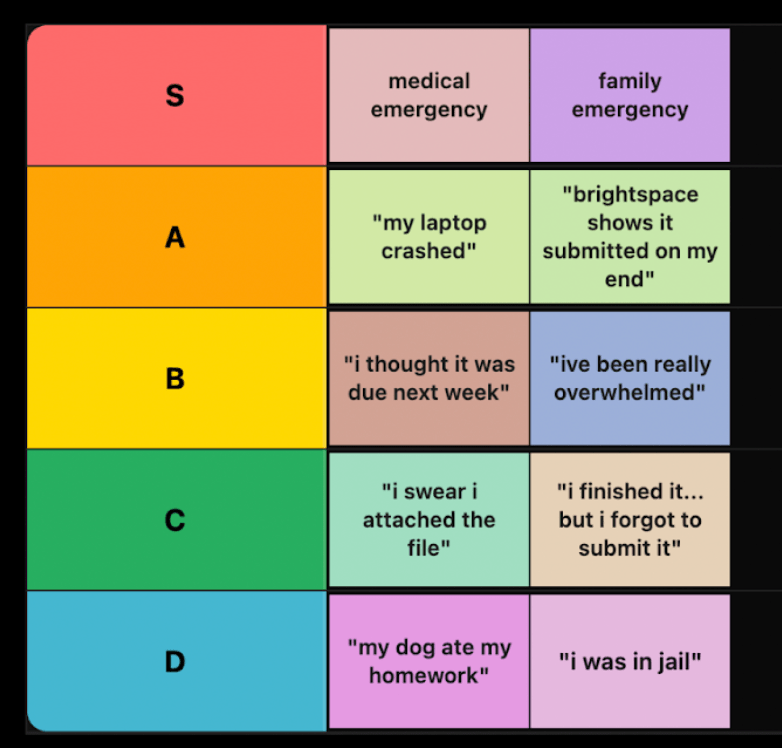
And in the spirit of transparency — and comedic healing — I proudly present the ranking of excuses students deploy when reality simply becomes too much.
S Tier — Professors Cannot Legally Argue
The Academic Emergency Exit
These excuses activate what we call Professor Humanity Mode.
At this level, professors don’t question details because doing so risks looking heartless. Health and family matters fall into the untouchable zone of academic policy. Whether every story is dramatic or not, this tier exists because sometimes life genuinely gets in the way. And everyone knows it.
The professor’s internal response is:
“Say less. Take care.”
No one wants to challenge illness or family crises. Even if suspicion exists, compassion wins.
This tier symbolizes situations where human well-being overrides academic deadlines.
Instant release granted.
A Tier — Strong Academic Defense
The Plausible Academic Mishap
Here, excuses rely on something every professor has experienced: technology and administrative confusion. This level is built on the fact that technology and logistics genuinely fail sometimes. Submission portals glitch. Files don’t upload. Deadlines get misunderstood.
Professors know these things genuinely happen.
They might suspect student error, but the scenario is believable enough to allow flexibility, especially if the student usually performs well.
This tier symbolizes:
“You probably messed up… but it could happen to anyone.”
Professors sigh, reopen the submission portal, and move on.
B Tier — Risky but Possible
The Professor Mood Gamble
These excuses can work — but only under the right conditions.
Success depends on:
- Professor mood
- Student reputation
- Timing
- How often you’ve used excuses before
These trigger the professor’s internal calculator:
Do I argue… or do I just let this go?
At this level, students send the email knowing it might not work — but trying still feels better than accepting defeat.
This tier symbolizes academic roulette.
Proceed with caution.
C Tier — Professor Knows, But You Try Anyway
The Desperation Tier
At this point, everyone knows what’s happening.
These are honest… but not convincing.
The professor knows the assignment was posted weeks ago. You know it too. But hope is not logical — it is emotional.
This tier symbolizes:
“I know this probably won’t work, but I have to try.”
Sometimes mercy happens. Usually, it doesn’t.
D Tier — Please Stop
The Transparent Lie Zone
Now we enter excuses professors have heard hundreds of times.
Professors read these emails with the same expression doctors have when patients diagnose themselves using Chat GPT.
This tier symbolizes excuses that worked in high school but have expired in college.
Results vary, but optimism is low. Professors reply politely… but the grade stays the same.
The Tier No One Wants to Reach
And finally, there’s the level where excuses actively make things worse. When evidence contradicts the story. When attendance patterns don’t match the sudden urgency. When credibility evaporates.
For example, getting caught in the cafeteria after saying you’re sick
At this stage, professors don’t get angry — they just remember.
And being remembered for the wrong reasons is an academic curse.
The Truth Professors Already Know
The secret everyone shares but no one says:
Most excuses come from panic, burnout, and poor time management — not bad intentions.
Students juggle work, family, mental health, social pressure, and academic demands, simultaneously. Sometimes things fall apart. And when they do, people scramble.
And, sometimes, survival mode kicks in.
Final Academic Reality
One day, current students will become managers, supervisors, maybe even professors themselves.
And when someone emails at 2 AM asking for more time…
They’ll understand exactly what happened.
Ianna Choi
Layout Editor
—————————————————————
Asian Outlook Magazine & Media releases blog posts every week, featuring different members of our incredible executive board and community. Please message us on Instagram or write to ao.editor@gmail.com if you want your thoughts published as a blog post! Also, send us any questions, comments or concerns!
 Asian Outlook | Art and Literary Magazine